

Quick answer
To make your wedding guest list, start with the budget: in Portugal in 2026, each guest costs €50 to €160 in catering alone. Write down every name, split them into an A-list and a B-list, put each household on one invitation and set rules for children, plus-ones and colleagues. Close the list before the invitations go out, 3 months before.
- per guest, catering alone, in 2026
- €50 to €160
- per guest, catering alone, in 2026
- before the wedding: list closed and invitations sent
- 3 months
- before the wedding: list closed and invitations sent
- before: when the venue usually wants the final number
- 30 days
- before: when the venue usually wants the final number
How do you make a wedding guest list?
Make the list in three stages: the numbers first, then the names, then the cuts. Couples who start with names end up with 200 people and a venue for 120. Couples who start with the budget know from day one how far they can go.
Each of you writes your own list without crossing anyone off. Then you merge the two, remove duplicates and only then decide who stays. Tick the steps in this checklist as you go: it is saved in this browser.
Free tool
Your guest list, step by step
0 of 18 done
To write the names down, use our template. It has one row per person and the columns you'll need until the day: each family's invitation, the side, A-list or B-list, children, mobile number and dietary needs.
Wedding guest list template (CSV for Excel)
Opens in Excel and Google Sheets. 10 columns and 3 example rows with made-up names.
How many guests can your budget take?
Divide the venue and catering share of your budget by the price per person. In 2026, that share is usually 55% to 65% of the total. With a €20,000 budget and 60% for venue and catering, you have €12,000. At €110 a head, that's 109 guests.
The price per person depends mostly on the type of service. In 2026, catering in Portugal costs €50 to €160 per person. Ask your venue for its figure and check whether it includes drinks, VAT (IVA in Portugal) and the room hire.
What one guest costs in 2026
Catering: 2026 prices, updated in October. Everything included: the average of €21,127 for a wedding of 100 guests, from a 2026 market study published in May, divided by 100.
| Total budget | At €75 a head | At €110 a head | At €160 a head |
|---|---|---|---|
| €12,000 | 96 guests | 65 guests | 45 guests |
| €20,000 | 160 guests | 109 guests | 75 guests |
| €30,000 | 240 guests | 163 guests | 112 guests |
Our arithmetic: budget x 0.6 divided by the price per person, rounded down. The three prices are the top of each catering tier above.
Every name on the list costs at least that price per person. Ten fewer guests, at €75 or €160 each, save €750 to €1,600. To run the numbers with your own figures, use the calculator in what each guest costs. Everything else is priced in how much a wedding costs in Portugal.
How many guests does a wedding in Portugal have?
There is no official figure, but the data that exists points to 100 to 150 guests. A 2026 market study of wedding prices, by a Portuguese platform for hiring services and published in May, assumes a typical wedding with about 100 guests.
In a 2023 survey of 107 couples, more than half wanted to invite 101 to 150 people. One in four parties had more than 150, and only 7.4% expected fewer than 60. With so few replies, treat it as a pointer, not a national average.
At the same time, small weddings are growing. In February 2024, the same services platform counted 38% of ceremonies with fewer than 50 people, up from 33% in 2020. The two figures come from different samples: a survey of couples and a platform's own data.
A-list and B-list: how do you decide who's in?
The A-list is the people you can't get married without. The B-list is the people you'd love to have if there's room. Make both from the full list and keep the B-list to yourselves.
A-list
- Parents, siblings, grandparents and anyone you live with.
- The friends you've spent time with in the last year.
- Close family on each side, with the same rule for both.
- Gets the invitation first, at least 3 months ahead.
B-list
- More distant family, old friends, colleagues.
- Kept in order: who goes first if a seat frees up.
- Gets the invitation as the A-list noes come in.
- Closes about 8 weeks before, so there's still time to reply.
To decide which list someone goes on, ask the same three questions about everyone. Have you seen them in the last year? Would they invite you to their wedding? Do you both know them? If the answer is no to all three, they go on the B-list.
- 1
Count people, not invitations
One invitation to the Silva family can be four seats. Add children and plus-ones, because the caterer counts plates.
- 2
Cut by category, not by name
"Colleagues, only our direct team" or "no second cousins" are rules everyone understands. Cutting one person and keeping someone just like them is what offends.
- 3
Review the plus-ones
A plus-one neither of you knows is the easiest seat to free up. The rules are in the next section.
- 4
Move names to the B-list
Anyone who comes off isn't crossed out: they wait for a seat. If someone on the A-list says no, the first person on the B-list gets the invitation.
- 5
Family last
Touching close family leads to the hardest conversations. Leave it until there's no other way to cut.
Send the B-list invitations with the same care and the same reply deadline. Someone who gets one 8 weeks before still has time to make plans. To handle this stage without hurting anyone, see how to manage the B-list.
How do you organise the list by category and household?
Give each person a category and a side, and put each family or couple on one invitation. The category shows where to cut. The side shows whether the list is balanced. The invitation shows who replies for whom.
Keep the categories few: family on each side, friends and work cover most lists. Count each group before you move on to the next: draw a line underneath and write down the total. You'll see at once which group is growing too much.
On a family invitation, each person still has their own row. The invitation is one, but the venue counts every plate and the seating plan counts every chair. That's why the template has one row per person and a Group column with the invitation's name.
| Column | What to write |
|---|---|
| Name | One person's first name and surname. One row per person, children included. |
| Group | The invitation's name, the same for the whole family or couple: Example family. |
| Category | Family, Friends, Work or whatever suits you. |
| Side | Who is inviting: one of you, or both. |
| List | A or B. |
| Child | Yes or No. It counts for the menu and, at some venues, the price. |
| Phone | One per invitation is enough. Use it for reminders and to call anyone who doesn't reply. |
| Optional. | |
| Dietary needs | Vegetarian, gluten free, shellfish allergy. Always write them the same way. |
| RSVP | Coming, Not coming or Not known yet. |
The template's 3 example rows use made-up names. Delete them before you start.
In joinVows
Your guest list on joinVows
On joinVows, you paste this list into Guests, under Import from Excel. The import reads the Name, Email, Group and Category columns and shows what will happen before you save. People with the same Group go on the same invitation, and on your website one person from the family finds their name and replies for everyone. The phone number goes in each invitation's details, where the WhatsApp reminder is.
Create a free account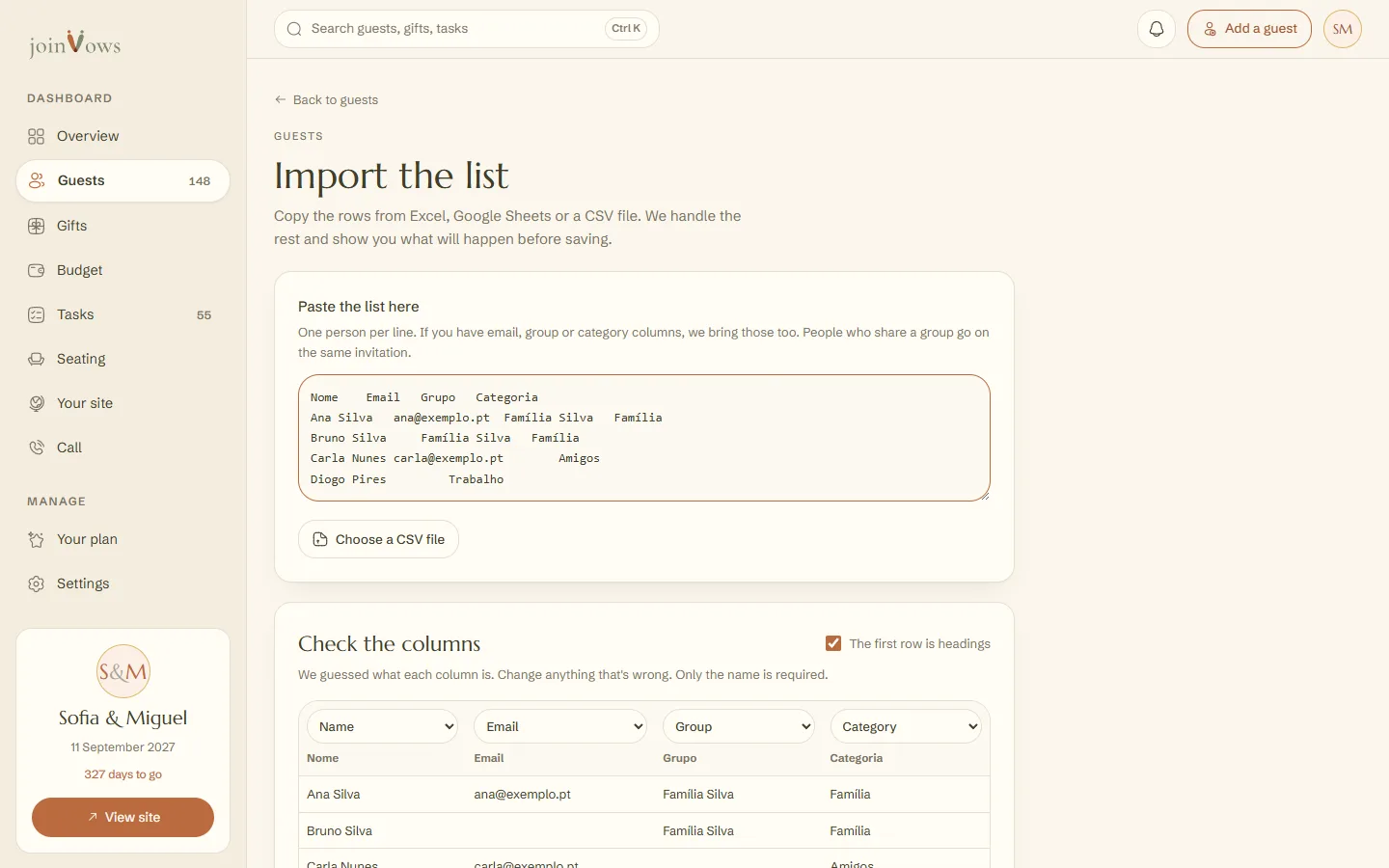
The steps are in import your list from Excel and households and invitations for several people. The guest list, with import and export, is in every plan.
Children, plus-ones and colleagues: what rules should you set?
Pick one rule for each case and apply it to everyone, on both sides. Arguments start when someone sees an exception made for someone else.
| Case | Possible rules | To avoid exceptions |
|---|---|---|
| Children | All; close family only; none | Write each child's name on the invitation. No name means the child isn't invited. |
| Plus-ones | Married, living together and engaged only; partners too; everyone | Put the partner's name on the invitation. A "+1" with no name opens the door to someone you've never met. |
| Colleagues | None; only those you see outside work; the whole direct team | Either the whole team, or only friends. Half the team is the worst option. |
| Distant family | Up to first cousins; only people you both know | The same line for each side. |
Children affect the price differently at each venue. The Gondomar quinta mentioned above doesn't charge for children's meals up to age 3 and gives 50% off from 4 to 9, in the published conditions we read in October 2026. Ask your venue before you decide. The pros and cons are in children at the wedding.
For plus-ones, the simplest rule is to invite the partner of anyone in a couple, with their name on the invitation. For everyone else, decide whether the invitation is for one person and say so clearly. Note down each guest's partner and children on the list, so they aren't left out of the count. More in plus-ones at the wedding.
For colleagues, there is no harm in leaving out an office colleague you aren't close to. Inviting a manager only makes sense if you invite their team.
How do you handle family pressure?
Agree with your parents how many seats each side gets before anyone writes a name. With a fixed number, "can I invite cousin Lurdes?" becomes a question your parents settle within their own seats.
- Decide together first, and only then talk to your families. That way you present a rule, not a doubt.
- Give each side a number of seats, not an open list. Anyone inviting within their seats doesn't need to ask permission.
- If your parents pay part of the wedding, it's fair to give them more seats. Agree how many at the start, and the list stays yours.
- Use the rules from the previous section as your answer. "We didn't invite anyone's colleagues" is easier to hear than a personal no.
- Each of you talks to your own family. Hard conversations go better with someone who knows the people.
When you have to say no, say it early, with a true reason and without over-apologising. These lines help you start.
Lines for saying no, and one for the B-list
Parents
We have room for 110 people and we're already over. Each side has 30 seats for family. You choose who fills yours.
Parents
We know you'd like to invite the neighbours. The wedding is small and we've kept it to family and the friends we see.
Children
Our wedding is adults only. We hope you enjoy a night off with us.
Children
Because of the venue, we've only invited children from close family. We hope you understand.
Plus-one
The invitation is just for you, as the venue is small. You'll be at a table with friends you know.
Colleagues
We're having a small wedding, just family and close friends. We'll have a dinner with the team afterwards to celebrate with you.
B-list
We'd love to have you at our wedding on 26 June. The details and the RSVP are on our website: ana-e-rui.joinvows.com
When should you close the guest list?
Close the A-list before the invitations go out, at least 3 months before the wedding. You need a rough number even earlier, before you book the venue, because the capacity you need depends on it.
Before booking the venue
A rough number
Budget and full list, so you know what capacity to look for.
6 months before
Save the date
Above all for guests coming from far away or abroad. See how to send a save the date.
3 months before
A-list closed and invitations sent
6 months before if guests are flying in from abroad.
Up to 8 weeks before
B-list invitations
As the noes come in, so they can still reply before the deadline.
4 to 6 weeks before
RSVP deadline
Leaves 2 weeks to remind anyone who hasn't replied.
30 days before
Final number to the venue
Check the date in your contract.
3 weeks before
Seating plan
Only with people who have confirmed.
The RSVP dates come from our guide what RSVP means and how to ask for it. Invitations go out at least 3 months before, and the save the date 6 months before for guests from far away. The 8 weeks for the B-list are our own arithmetic: enough time to reply before the deadline.
After the final number, every change affects the bill and the tables. The closed list becomes the base of your seating plan: who confirmed, who they're coming with and what they eat.
FAQ
What is considered a big wedding guest list?
In Portugal, more than 150 guests is on the big side. In a 2023 survey of 107 couples, one in four parties had more than 150 people, and more than half of couples wanted 101 to 150. A 2026 market study assumes a typical wedding of about 100 guests. Weddings under 50 people are a growing share.
How do I make a wedding guest list in Excel?
Use one row per person and a column with the invitation's name, to group each family. Add columns for category, side, A-list or B-list, children, mobile number, dietary needs and RSVP. Our template already has these columns and opens in Excel and Google Sheets.
Can parents invite whoever they want?
They can invite within the seats they agree with you. Give each side a fixed number before anyone writes a name. If parents pay part of the wedding, it's fair for them to have more seats, agreed at the start. The final list is still the couple's.
Does every guest get a plus-one?
No. A simple rule is to invite the partner of anyone married, living together or engaged, with their name on the invitation. For single guests, decide one rule for everyone. An invitation without a plus-one is for one person, and it's best to say so clearly.
How do I say the wedding is child-free?
Write only the names of the people invited on the invitation, and say it on your website or in a message too: "our wedding is adults only". Tell people early, so parents have time to find someone to look after their children. If you make exceptions, follow a clear rule, such as children from close family.
Should I invite work colleagues?
Only if they're friends, or if you invite the whole team. Inviting half a team is the hardest choice to explain. If the wedding is small, say exactly that: family and close friends only. One rule for everyone stops anyone feeling left out.
How far ahead should you make the guest list?
Have a rough number before you book the venue, because the capacity depends on it. The A-list is closed when the invitations go out, at least 3 months before the wedding, or 6 with guests coming from abroad. B-list invitations go out up to about 8 weeks before.
What is a B-list for a wedding?
It's the list of people you'd invite if there's room. When someone on the A-list says no, the first person on the B-list gets the invitation. Keep it in order, send invitations up to about 8 weeks before and keep it to yourselves: nobody likes to know they were a second choice.
Written by
Ielga OliveiraIelga Oliveira is part of the joinVows founding team. joinVows is the Portuguese wedding website platform that keeps the guest list, RSVPs, gifts and seating in one place.
Ielga writes the blog's guides from the questions couples ask us. Every price, deadline and legal rule has its source listed at the end of the article, with the date it was checked.
Sources · 12 checked for this guide
- Loja da Noiva: Quanto custa um casamento em Portugal? Contas de 2026 (wedding costs in 2026)checked 20 October 2026
- Postal: Este é o preço médio de um casamento em Portugal (average wedding price, Fixando data)checked 20 October 2026
- HR Portugal: Dizer sim está mais caro (wedding service prices in 2026)checked 20 October 2026
- ECO: Casar está mais caro (ISAG and CICET-FCVC survey of couples, 2023)checked 20 October 2026
- Postal: Casar custa mais 5.000 € face a 2020 (wedding sizes, Fixando data)checked 20 October 2026
- Doutor Finanças: Que prenda de casamento devo oferecer? (how much to give)checked 20 October 2026
- casamentos.pt: Quinta dos Serras: conditions and menuschecked 20 October 2026
- Quinta do Gaio de Cima: General conditions (Condições gerais)checked 20 October 2026
- casamentos.pt: Conselhos para definir a lista de convidados (advice for the guest list)checked 20 October 2026
- casamentos.pt: 5 sins e 5 nãos para a tua lista de convidados (guest list dos and don'ts)checked 20 October 2026
- casamentos.pt: A entrega dos convites de casamento (delivering wedding invitations)checked 20 October 2026
- e-konomista: Etiqueta de casamento (wedding etiquette)checked 20 October 2026