Quick answer
Make your wedding seating plan after the RSVP deadline, about 3 weeks before the day, with only the guests who said yes. A round table seats 8 to 12 people: 10 at a 1.6 m table, 10 to 12 at a 1.8 m one. With 100 guests and tables of 10, you need 10 tables, plus the top table.
- before the wedding: finish the plan, after the RSVP deadline
- 3 weeks
- before the wedding: finish the plan, after the RSVP deadline
- people per round table of 1.3 m to 1.8 m, at three Portuguese rental firms
- 8 to 12
- people per round table of 1.3 m to 1.8 m, at three Portuguese rental firms
- of 10 seats for 100 guests, plus the top table
- 10 tables
- of 10 seats for 100 guests, plus the top table
When should you make the wedding seating plan?
Make the seating plan after the RSVP deadline, once you know who is coming. In the calendar from our RSVP guide, the reply deadline falls 4 to 6 weeks before the wedding, the final number goes to the venue 30 days before, and the plan is finished 3 weeks before. Seating people who haven't replied means redoing whole tables later.
The room can start earlier. As soon as you've booked the venue, ask for a floor plan with measurements, doors and exits. With a rough guest count you can already choose table shapes and where the top table goes. Sketch the room and work out how many people the tables hold.
As soon as you book the venue
Ask for the floor plan
Measurements, doors, emergency exits, dance floor and bar. Ask what tables the venue has and how many each seats.
4 to 6 weeks before
RSVP deadline
Only after this date do you know who is coming. Call anyone who hasn't replied.
30 days before
Final number to the venue and caterer
The exact date is in your contract.
3 weeks before
Finish the seating plan and send it
Only confirmed guests, with dietary needs and children marked.
In the last week
Deal with cancellations
Change what you need, send the new version and print the table plan and place cards.
The day before
Hand over a printed copy
To the venue's floor manager, with a pen and blank cards for surprises.
How many tables do you need for your guests?
Take the top-table seats away from your head count, divide by the seats per table and round up. With 100 people, a top table of 8 and round tables of 10, you need 10 tables, with 8 seats to spare. With tables of 8, it's 12. With tables of 12, it's 8.
Free tool
How many tables you need
The sum: people seated minus the top-table seats, divided by the seats per table, rounded up. Tables of 8, 10 or 12 seats, like those rented out by three Portuguese table rental firms (Vila do Conde, Maia and the Algarve), checked in October 2026. The top table of 8 follows the protocol order.
Count everyone who needs a chair: the two of you, children who eat at the table, and suppliers who eat in the room, such as the photographer or the band. For babies, ask the venue whether it has high chairs, and how many.
Spare seats give you room to move. One empty chair at a table covers a late RSVP or a change of mind. If you have lots left over, drop a table and gain floor space. Remember that every filled seat costs one person's catering: see what each guest costs.
Round or long tables: how many people fit at each?
A round table seats 8 to 12 people depending on its diameter, and a 1.9 m rectangular table seats 6. The table below collects what three Portuguese event furniture rental firms state on their product pages, as of October 2026. Your table layout starts from these sizes.
| Table | Size | People |
|---|---|---|
| Round | 1.30 m diameter | 8 |
| Round | 1.52 m (the 5 ft table) | 8 |
| Round | 1.60 m | 10 |
| Round | 1.80 m (about 6 ft) | 8 to 12 |
| Round | 2.10 m | 15 |
| Rectangular | 1.90 m x 0.80 m | 6 |
| Rectangular | 2.00 m x 0.90 m | 8 to 10 |
Product pages from three table rental firms, in Vila do Conde (near Porto), Maia and the Algarve, read on 20 October 2026. For the 1.8 m table, one firm gives 8 to 10 people and another 12.
Look at the 1.8 m table: the Algarve firm sets it for 8 to 10 people and the Vila do Conde firm for 12. The maths explains it. The edge of a 1.8 m table is about 5.65 m long: that gives each person 57 cm with 10 seats and 47 cm with 12. On the 1.9 m rectangular table, with 3 a side, each person gets about 63 cm.
Don't seat more than ten people at a round table. Ask your venue what tables it has and how many seats it usually sets them for. If the venue has its own tables, those are the ones to plan with.
Round tables
- Everyone can see the whole table and talk to everyone.
- One family or group of friends fills a table of 8 to 10.
- The most traditional format.
- They take up more floor: chairs need room to pass between tables.
Long (banquet) tables
- More people in the same length, and the feel of a family dinner.
- People mostly talk to whoever is beside and opposite them.
- Groups sit along stretches of one table, with no clear break.
- Less need for named seats: long tables usually do without them.
In Portugal a long banquet table is called a mesa imperial: a row of rectangular tables pushed together. Five 1.9 m tables make a 9.5 m table with 30 seats along the sides, plus one at each end. A large mesa imperial can seat about 70 people. You can also mix: round tables for most guests and a long one for the top table or a big group.
Top table: what are the options?
There are five common formats, and none is compulsory. The traditional Portuguese top table, the mesa presidencial, seats the couple, both sets of parents and the padrinhos (the Portuguese equivalent of best man and maid of honour, often couples), but today many couples sit on their own. Whatever the format, the table should be in view of everyone, at one end of the room or in the middle.
| Format | Who sits there | When it works |
|---|---|---|
| Mesa presidencial | The couple, the parents and the padrinhos, 8 to 10 seats | Weddings that follow protocol |
| Sweetheart table | Just the two of you, facing the room | Divorced parents, big families, couples who want to be seen |
| Close family | The couple with parents and siblings, or with grandparents | When the padrinhos are happy at another table |
| With friends | The couple with the padrinhos, siblings and close friends | Relaxed weddings |
| Middle of a long table | The couple in the centre, with everyone at the same table | Small weddings, outdoors |
One order Portuguese protocol uses: the bride sits on the left, with her father beside her and her mother next. The groom sits on the right, with his mother beside him and his father next. The padrinhos come after the parents. If someone can't come, the seat goes to a close relative or to their partner.
Choose the format before you seat the other tables, because it decides who sits at the tables nearest you. Who sits where, in more detail, is in our guide to the top table and sweetheart table.
Who sits with whom: the rules that avoid trouble
Group people by what connects them: family, school friends, colleagues. Then deal with the delicate cases one by one. The table shows where to seat each one.
| Who | Where |
|---|---|
| Divorced parents | At your table, if they get on. If not, each at their own family's table, both in the front row. |
| Grandparents and older guests | At the quietest, roomiest table, never near the band or DJ. Somewhere easy to reach, near the exit and the toilets, for anyone who walks slowly. |
| Young children | Ask the parents whether they want them at their table. A children's table goes near the parents, with colouring books. |
| Teenagers | A table of their own, where they can get to know each other. |
| Guests who know nobody | At a table with people they have something in common with, never alone among strangers. |
| Single friends | With couples and friends they know. Skip the singles table. |
| Exes and people who have fallen out | At different tables, not facing each other. |
| Friends who will dance | Near the dance floor and the music. |
| Guests who speak another language | Next to someone who speaks their language. |
You don't need to please everyone at every table. It's enough that each person knows someone, or has something in common with the others. Also mix relatives from both sides and friends from different groups, unless they don't share a language. At a wedding in Portugal with guests from abroad, that last point matters: seat each overseas guest next to at least one person who can talk to them.
How to make the seating plan, step by step
Seat the big blocks first and the loose individuals last. This method works on paper, with one colour of sticky note per group, or in a digital tool.
- 1
Ask for the floor plan
With measurements, doors, emergency exits, dance floor and bar. Ask what tables the venue has and how many seats each takes.
- 2
Start from the confirmed list
Only the people who said yes. Group them by family and friendship group, with children and dietary needs marked. A wedding guest list sorted by group saves you this step.
- 3
Place the top table and the family tables
Your table first. Then parents, grandparents and padrinhos at the nearest tables.
- 4
Seat each family as one block
A family of 4 doesn't get split up. Fill tables with whole families first, and only then with individuals.
- 5
Bring the friendship groups together
School friends with school friends, colleagues with colleagues. Those who will dance go near the floor.
- 6
Fit in whoever is left
Each person on their own goes to a table where they know someone or share something with the others.
- 7
Check the delicate cases
Divorced parents, exes, grandparents away from the speakers, children near their parents. Use the table in the section above.
- 8
Let the plan rest for a day
Leave the draft on the table for a day or two before you finish it. With fresh eyes, you spot what doesn't fit.
- 9
Send it to the venue and caterer
With the floor plan, the names table by table and the dietary needs. The last section lists what the plan should include.
On paper, you can see the whole plan on one big table, but every cancellation means moving several notes. In a digital tool, a change takes a minute and the list of people still to seat updates itself.
In joinVows
The seating plan on joinVows
In Seating, you answer a few questions (how many people, which tables, how many seats, top table, dance floor and bar) and the room is set up. Guests who RSVP on your website appear in To seat. You drag a person, or the whole family, onto a table, or press Seat everyone left, with families kept together. It is on the Elegante and Único plans (how it works).
Create a free account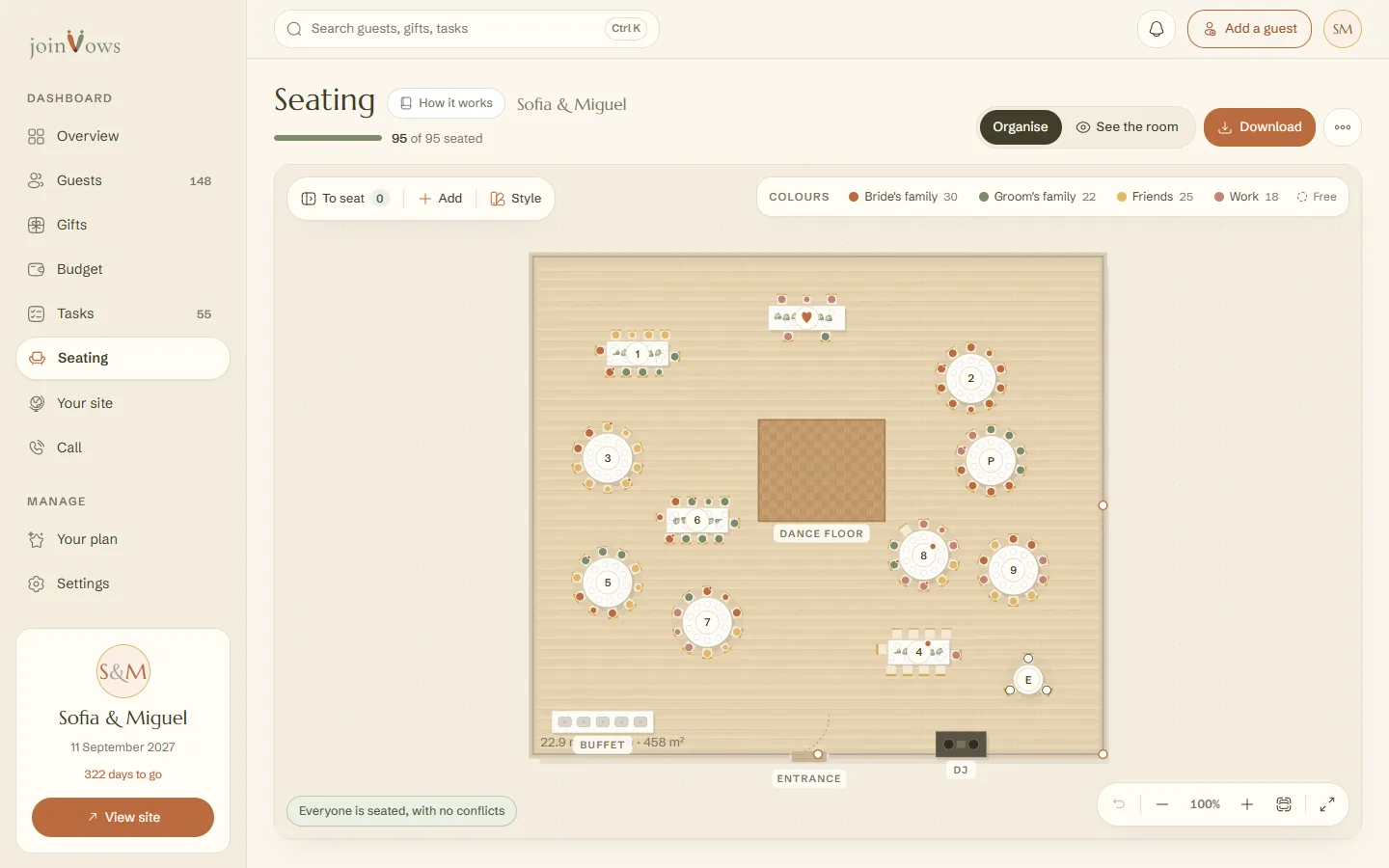
Table plan board and place cards: how guests find their seat
At the entrance to the room, a board tells each guest where to sit. In the UK it's usually called the table plan; in Portugal, the placard das mesas or mapa de mesas. It can be laid out by table, with the names at each one, or alphabetically, with each name and its table.
With a lot of guests, an alphabetical list is quicker to read: each person looks for their own name instead of scanning table by table. Each table gets a number or a name. At the table itself, you decide whether to give everyone a named seat or let them choose their chair.
Named seats
- You decide who sits next to whom.
- The caterer knows where each dietary need and each child is.
- More work: one card per person, and every change moves two seats.
Named tables only
- Each table sorts itself out.
- Fewer cards to make and fewer last-minute changes.
- Works well with long tables and relaxed weddings.
Place cards, the card with a name at each seat, and table numbers have a guide of their own: table names and place cards for your wedding. It also has ideas for naming tables instead of numbering them.
What plan should you give the venue and caterer?
Give the venue a printed copy or a PDF with everything the floor staff need to set up and serve. The deadline is in your contract. If it isn't, send the plan as soon as it's finished, about 3 weeks before, after the final number. If the venue team mostly speaks Portuguese, ask whether they'd like the plan in Portuguese.
What the venue's plan should include
- The floor plan, with every table numbered or named, plus the dance floor, bar and exits
- The names table by table, and each person's seat if you're using named seats
- Dietary needs, at the table and the seat of the person who has them
- How many adults and children at each table, and where the high chairs go
- The suppliers' table: photography, video and music
- The alphabetical list for the board, if the venue prints it
- The version date, so two versions never circulate
The venue may ask for changes to the layout. A Portuguese wedding estate (a quinta) writes in its general conditions that it may refuse a table layout that blocks emergency exits or fire extinguishers. One more reason to start from the venue's real floor plan.
On joinVows, Download, in Seating, makes these sheets from your plan: the floor plan, table by table, the caterer's summary with dietary needs, and the alphabetical list for the entrance. Each sheet shows when it was made (the seating PDF).
FAQ
How do you create a wedding seating plan?
Start after the RSVP deadline, with only the guests who are coming. Ask for the floor plan, place the top table and the family tables first, seat each family as a block and bring friendship groups together. Then fit in whoever is left and check the delicate cases: divorced parents, grandparents and children. Finish the plan about 3 weeks before.
How many tables for a 100 person wedding?
With round tables of 10 and a top table of 8, you need 10 tables for 100 people, with 8 seats to spare. With tables of 8, it's 12 tables. With tables of 12, it's 8. Count the two of you and any suppliers who eat in the room, such as the photographer.
Who should sit at the top table?
At a traditional Portuguese top table, the mesa presidencial, the couple sits with both sets of parents and the padrinhos. Today many couples prefer a sweetheart table for two, or just parents and siblings. If parents are divorced and don't get on, each can sit at their own family's table, both near yours.
Is there a set order for who sits where at the top table?
One common order in Portuguese protocol puts the bride on the left, with her father and then her mother beside her. The groom sits on the right, with his mother and then his father. The padrinhos come next. Other tables have no fixed order: people are grouped by family and friendship. At the top table, the bride is served first.
How many people fit at a round table?
It depends on the diameter. According to three Portuguese table rental firms, checked in October 2026, a 1.3 m or 1.52 m table seats 8, a 1.6 m table seats 10, a 1.8 m table seats 8 to 10 or 12, depending on the firm, and a 2.1 m table seats 15. Don't seat more than ten people at a round table.
When do you give the seating plan to the venue?
Check your contract: the date is there. If there's no date, send the plan as soon as it's finished, about 3 weeks before, after you've given the final number. If anything changes, send a new version with its date and bring a printed copy on the day.
Do guests need named seats?
No. You can assign tables only and let everyone choose their chair. Named seats help when there are dietary needs or children, because the caterer knows where to serve each dish. With long tables and relaxed weddings, named tables are usually enough.
Written by
Ielga OliveiraIelga Oliveira is part of the joinVows founding team. joinVows is the Portuguese wedding website platform that keeps the guest list, RSVPs, gifts and seating in one place.
Ielga writes the blog's guides from the questions couples ask us. Every price, deadline and legal rule has its source listed at the end of the article, with the date it was checked.
Sources · 18 checked for this guide
- Amado: Round table for 8 people (1.30 m)checked 20 October 2026
- Amado: Round table for 10 people (1.60 m)checked 20 October 2026
- Amado: Round table for 12 people (1.80 m)checked 20 October 2026
- Amado: Round table for 15 people (2.10 m)checked 20 October 2026
- Amado: Rectangular table 1.90 x 0.80checked 20 October 2026
- Akiloc: Folding round table rental (152 cm)checked 20 October 2026
- Alma da Festa: Tables (rental)checked 20 October 2026
- casamentos.pt: Tips for organising the reception tables (Dicas para organizar as mesas)checked 20 October 2026
- casamentos.pt: Table types for the banquet (Tipos de mesa para o banquete)checked 20 October 2026
- casamentos.pt: Who to seat at the couple's table (Quem sentar na mesa dos noivos?)checked 20 October 2026
- casamentos.pt: How to seat separated parents at the wedding (Pais separados)checked 20 October 2026
- casamentos.pt: Mistakes to avoid in the seating plan (Erros no seating plan)checked 20 October 2026
- Zankyou: How to make your wedding seating plan in 5 stepschecked 20 October 2026
- Simplesmente Branco: Tips for creating your wedding seating planchecked 20 October 2026
- LP Wedding: Quinta do Roseiral: wedding and table protocolchecked 20 October 2026
- Quinta do Gaio de Cima: General conditions (Condições gerais)checked 20 October 2026
- The Lawrence: How to make a wedding seating planchecked 20 October 2026
- Prismm: Step by step wedding seating chart guidechecked 20 October 2026